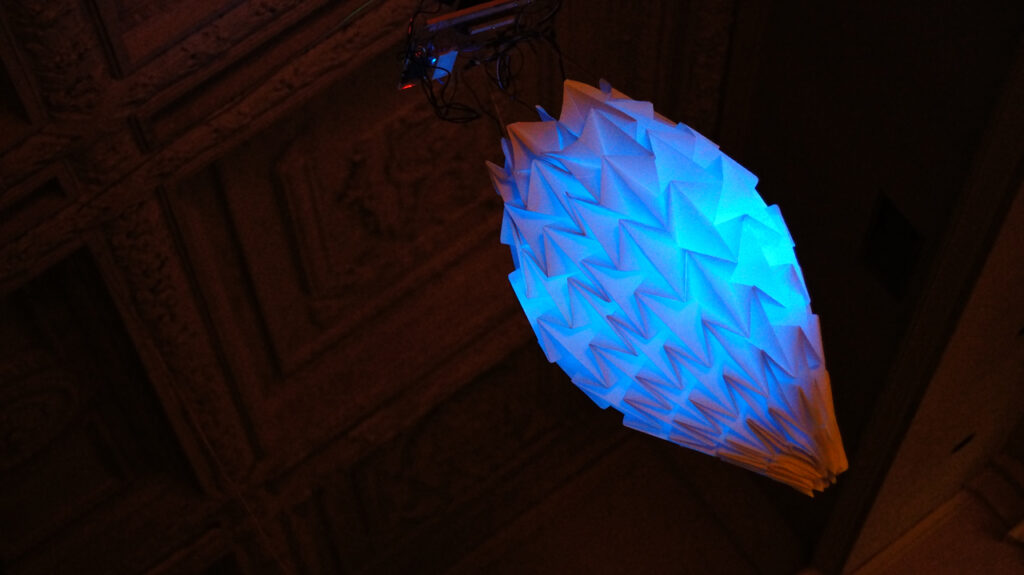
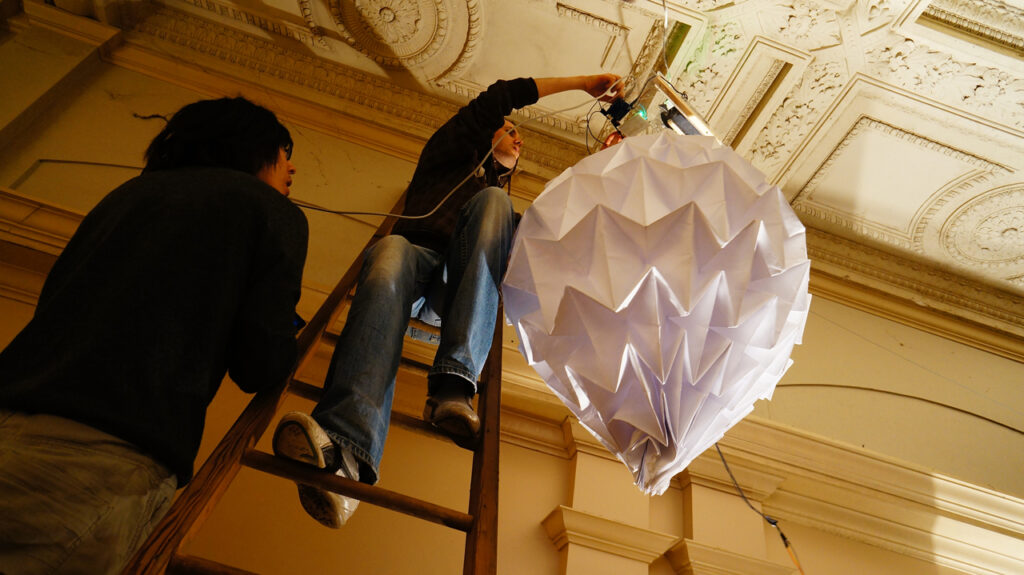
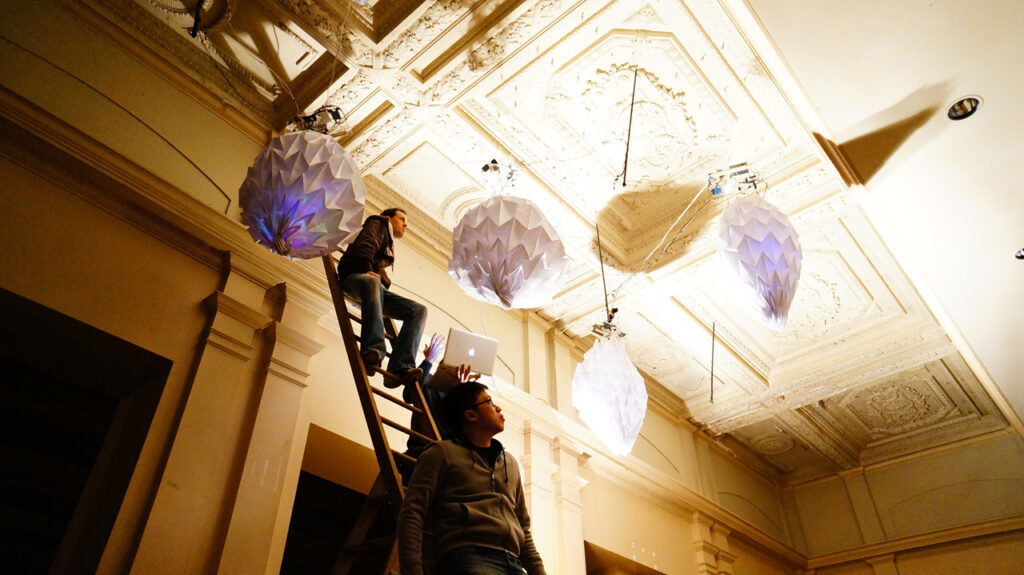
A project that creates a dynamic between the exhibit and the onlooker. With all the technology available to us, hardwired and wireless, there could be a stronger link between our consciousness and the environment we impact.
We aimed to develop a design prototype using simple methods of construction and electronics to obtain a visually complex presentation.
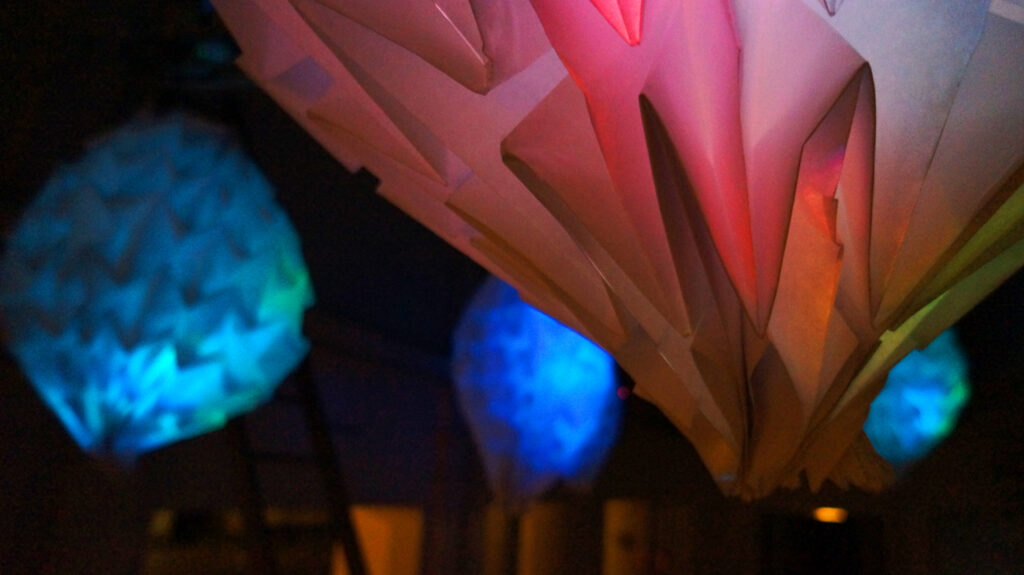
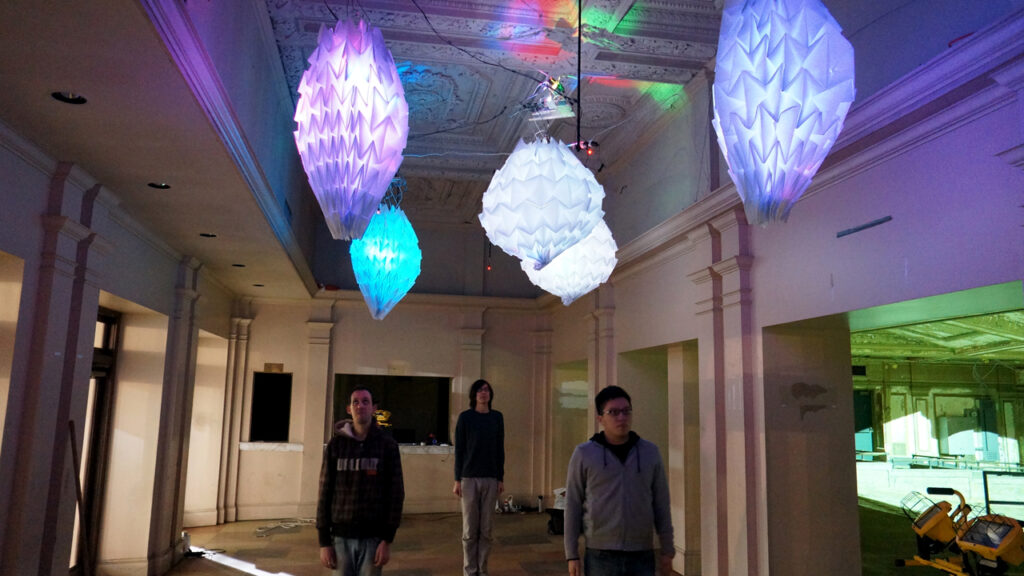
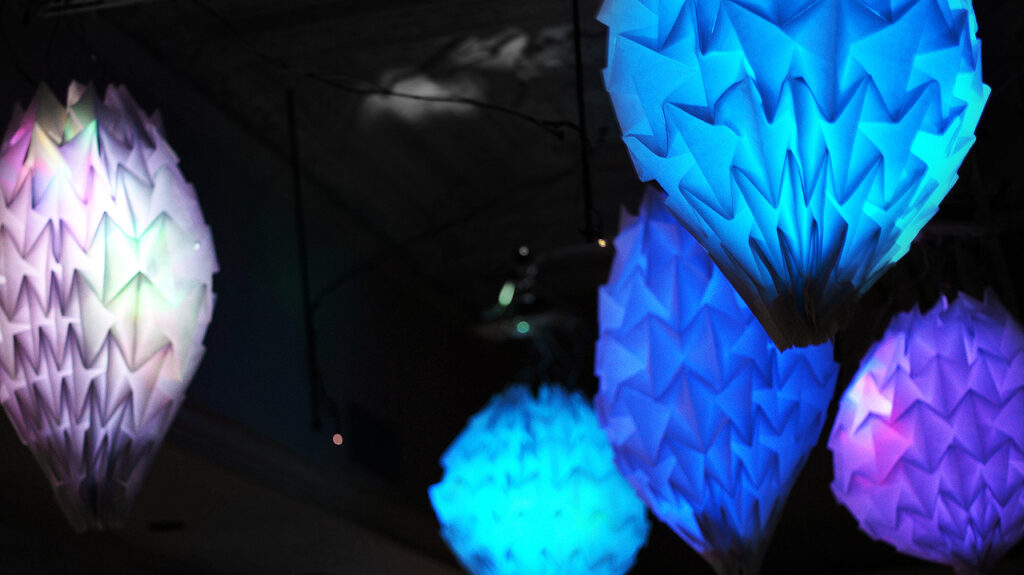
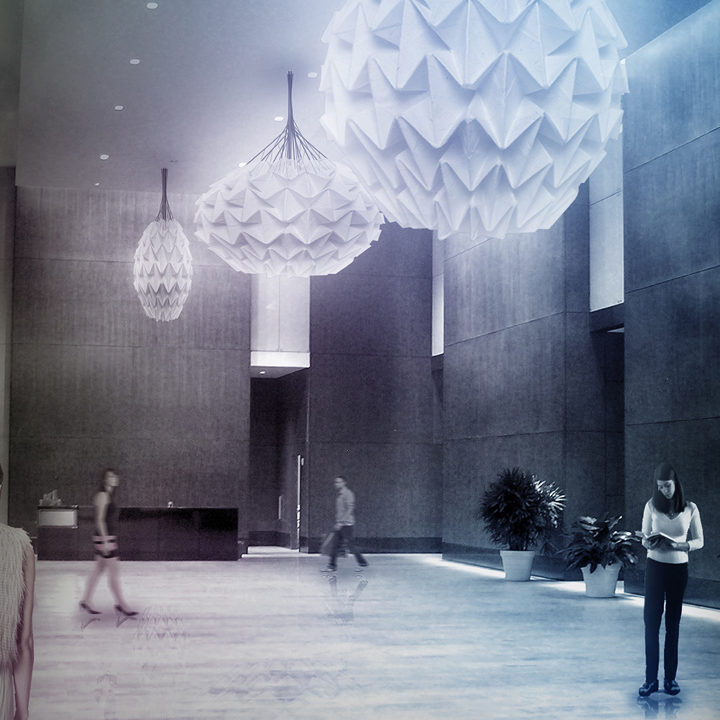
The presentation consists of a floating overhead installation of five blossoms that are interactively linked to various hot spots. Each blossom pulsates slowly while hovering in the dim lit space. As the user walks through the exhibit the blossoms react inversely to the users position. The pulsating stops and the blossom flowers. While the user remains on the hot spot the flowered blossom is frozen in an animated state, until they move on. The blossom then retracts and returns to a pulsing state.
During the evening, the user interaction turns into a dynamic light show. Taking advantage of a dimly lit room, the blossoms expose themselves through a transformation of both form and light. The glow from each blossom changes in color temperature and intensity depending on the duration of the user interaction.
The idea is a simple one, and the true complexity and intrigue is experienced by the user. Informing a conscious understanding of the environment they are in.
The process for the layout of the design itself will be driven by the interior space provided to us. Similarly the placement of interactive nodes and hot spots will be informed by this.
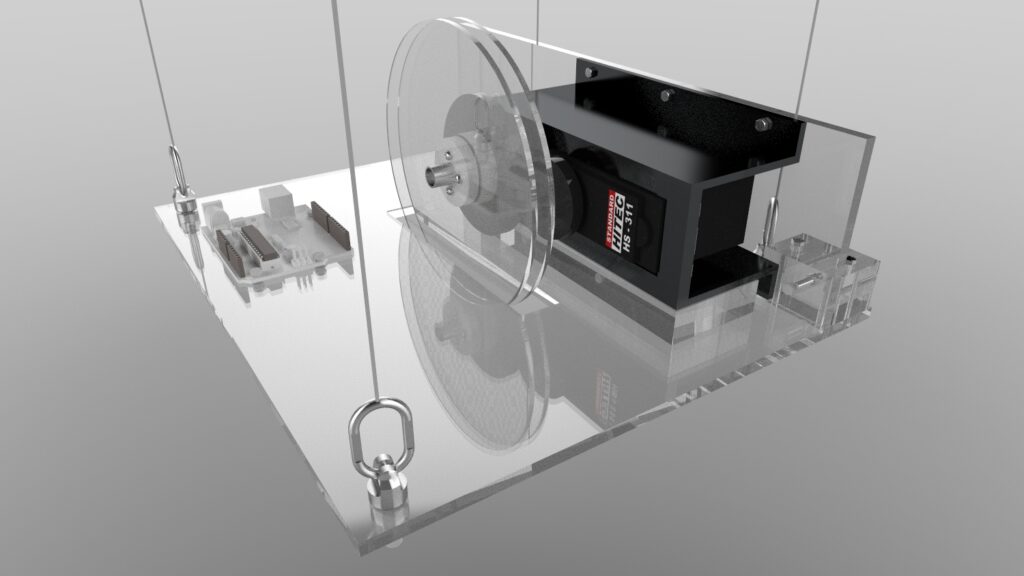
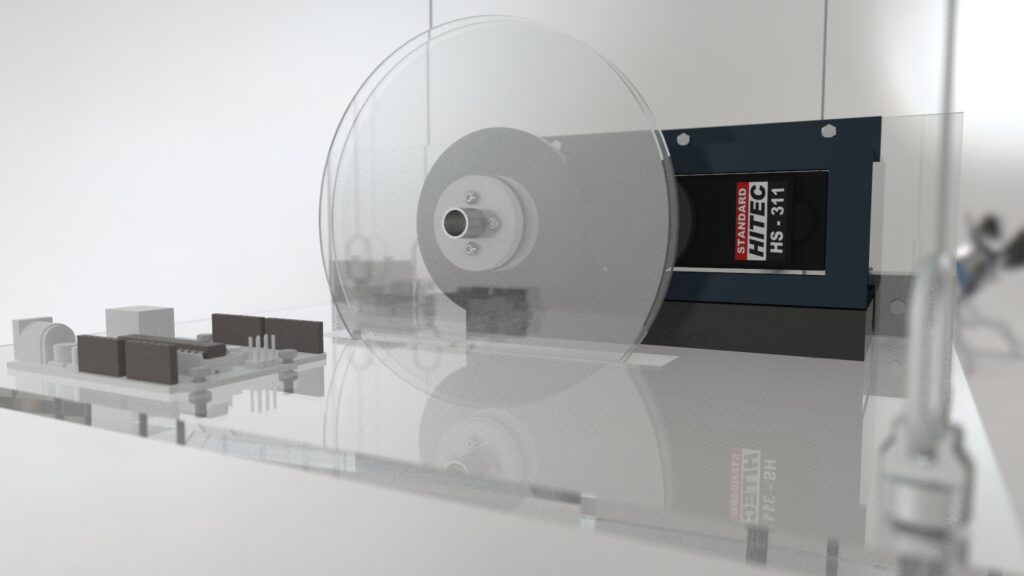
Electronics Breakdown
MicroController x 5
Power Supply for MicroController x 5
Heavy Duty Gear Drive Pan System SPG805A-BM-CR Servo Power
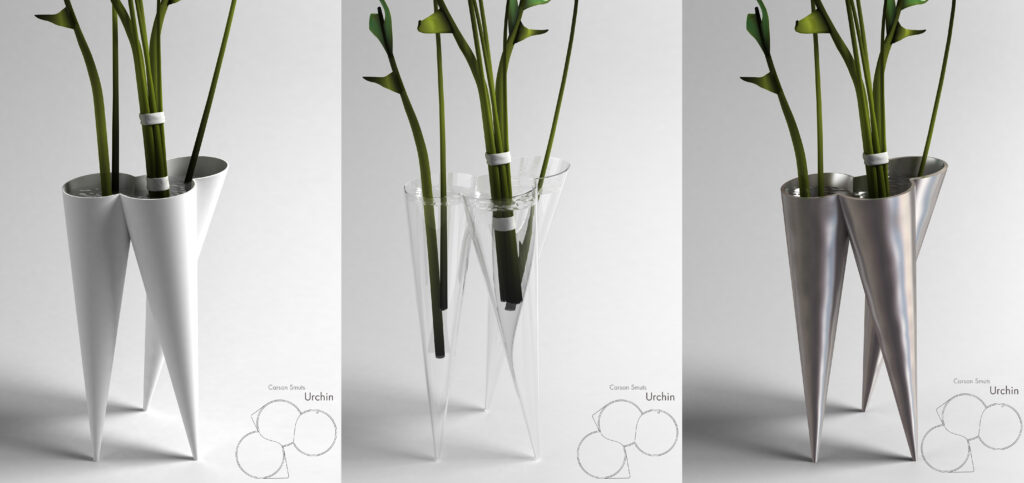
Carrol Boyes 2010 METAL competition – Winning Design by Carson Smuts.
“Titled “The Urchin” this piece is both unique and deceptively simple. The careful arrangement of the three “spines”around a central pivot results in a radial symmetry creating balance and harmony. Poised on three points as if ready for action, “The Urchin” radiates an energy that encourages this piece to be used either as a “stand alone” feature oras a vessel.” – Carrol Boyes WebSIte
Neural Alley, is an interactive analog installation that interjects in the flows and paths of the daily urban commuter. On either side of the alleyway hangs a canvas of pixel blocks. Each make up a larger image that spans the depth of the alley. These images start off by depicting arteries of the Tennessee river and evolve over time through interactions with the passers by.
a design and installation by
Carson Smuts, Noa Younse and Jenny Hiser
Temporal Art
Tension between the two sides of the alleyway (the two images) is temporal and fluctuates depending on the number of people passing through the space. People will act as the only conduit between the two.
The images are filtered over time. This image filter is not based on an algorithm like a digital image filter, but rather by an aggregation of chance events that may take place when a passer by wonders through this spatial conduit. The result is a spatial fuzzy logic.
Mosquito is a plugin suite developed for Rhino3D and Grasshopper by Carson Smuts. Developed while teaching with Mario Gooden and Mabel Wilson at Columbia GSAPP in 2011, the plugin allowed designers to tap into social , financial and popular media. Extracting location, profiles, images and messages from etc…. (note: Facebook and Twitter plugins are currently not working)
As architects there is a responsibility to consider the practices that play out in public spaces. However, people now also dwell in the digital equivalent, namely, social media space. While this space becomes ever more permanent, the physical realm is fleeting, an evanescent space with a layer of digital.
Mobile tech at our disposal blends digital and physical space creating a slippage between the proximal and distal. They may not intersect, but whether you agree or not with nature of social media, it is important to remain critical from both sides.
We are utilizing the tools in this component suite to bridge the gap between physical geometries and digital data. Driving geometry with data and vice-versa. The ability to extract user Geo-coordinates, language, thoughts, profile and image enables architects to paint a picture. It is this 4-dimensional picture, which we refer to as “spatial condition”, that allows us to explore what happened yesterday, now and hypothesize about tomorrow. True 4-dimensional modeling.